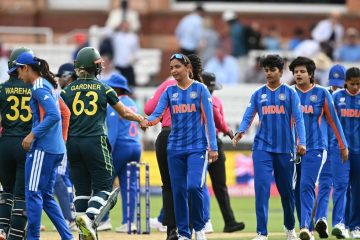
- India has named G Kamalini as a replacement for Yastika Bhatia in their Asian Games women’s cricket squad.
- The team aims to defend their gold medal against seven other teams at the event.
- This shift in the lineup reflects a strategic approach to enhance batting performance.
- The squad's composition emphasizes a blend of experience and youth, crucial for the high-stakes tournament.
- India’s tactical focus on all-rounders could be pivotal in maintaining dominance in women’s cricket.
India’s women’s cricket squad has been officially announced as they gear up to defend their gold medal at the Asian Games in September 2026. The Board of Control for Cricket in India (BCCI) has made a noteworthy change by replacing Yastika Bhatia with G Kamalini, a move that underscores the team’s strategic ambitions as they prepare to face seven competing nations. This shift not only alters the team’s dynamics but also sets the stage for tactical innovations that could prove decisive in their quest for victory.
The Asian Games represents a crucial chapter in the narrative of women’s cricket, particularly for India, which has established itself as a powerhouse in the sport. With the pressure of being the defending champions, the expectations are high. The BCCI’s decision to include Kamalini suggests a desire to bolster the batting lineup, while also hinting at a more aggressive approach to their play.
G Kamalini’s inclusion is particularly intriguing given her recent performances in domestic cricket. Her ability to anchor the innings while also accelerating the scoring rate makes her a valuable asset. This tactical choice may indicate a shift towards a more versatile batting strategy, allowing for flexibility in the middle order. The Asian Games will not only test the players’ skills but also their adaptability in facing varied opponents, each with distinct playing styles.
Tactical Breakdown: Understanding India’s Strategy
Analyzing India’s women’s cricket squad reveals that the BCCI is focused on tactical versatility. The inclusion of G Kamalini is not the only adjustment; the squad is expected to embrace a formation that maximizes both batting depth and bowling variations. The core of the team appears to be built around a blend of seasoned campaigners and emerging talents, which plays into the overall strategy of maintaining a competitive edge.
A significant aspect of India’s tactical approach will be how they utilize their all-rounders. In the context of the Asian Games, all-rounders serve a dual purpose: they can stabilize the batting order while also contributing crucial wickets. This is critical in limited-overs formats such as ODIs and T20s, where the balance of innings can shift dramatically within a few overs.
Key battles are expected to unfold in the middle overs, where India’s strategy will hinge on the performance of both their spin and pace departments. The ability to take wickets at critical junctures will be paramount, especially as teams look to post challenging totals. The focus on wicket-taking bowlers, complemented by the deft batting of players like Kamalini, could prove to be a game-changer.
Furthermore, the mental aspect of the game cannot be overlooked. The pressure of defending a championship is immense, and how the squad manages that pressure will be a focal point. Team cohesion and morale will be vital in navigating the challenges posed by their opponents, each aiming to dethrone the reigning champions.
The Road Ahead: Expectations and Challenges
As the Asian Games draw nearer, the stakes for India’s women’s cricket squad have never been higher. The competition will not only test their cricketing skills but also their capacity to handle the weight of expectations. The dynamics within the squad, particularly with the introduction of new players, will play a crucial role in shaping the team’s performance.
The upcoming matches will reveal whether the BCCI’s strategic choices pay off. With a strong emphasis on both batting and bowling, the squad seems well-prepared to tackle the challenges that lie ahead. If G Kamalini can step up and deliver impactful performances, India may just find the edge they need to reclaim their title.
The Asian Games serve as a vital platform for women’s cricket, showcasing the talent and resilience of female athletes. As India embarks on this journey, the world will be watching closely, eager to see if they can rise to the occasion once more.
Our perspective on India's women’s cricket squad for the Asian Games leans towards cautious optimism. While the inclusion of G Kamalini is a strategic move, it is crucial to understand how her integration into the team will alter existing dynamics. We believe that the blend of experienced players and fresh talent could create a more unpredictable batting lineup, making it difficult for opposition teams to formulate effective strategies against them.<br />
However, the pressure of defending a gold medal cannot be underestimated. The psychological aspect of the tournament will be just as important as technical skill. It will be fascinating to see how the players navigate this mental landscape and whether they can harness the collective experience to perform under pressure. In our view, the Asian Games could serve as a turning point for women's cricket in India, influencing how the sport evolves and gains recognition on a global scale.
Source: India names Asian Games women’s cricket squad; G Kamalini replaces Yastika Bhatia
Sports News Plus is a news aggregator. We do not own or claim rights to any images, videos, or source content featured on this site. All images and media are the property of their respective original owners and publishers. Article content is independently written based on publicly available news sources, which are credited and linked throughout. Full disclosure →