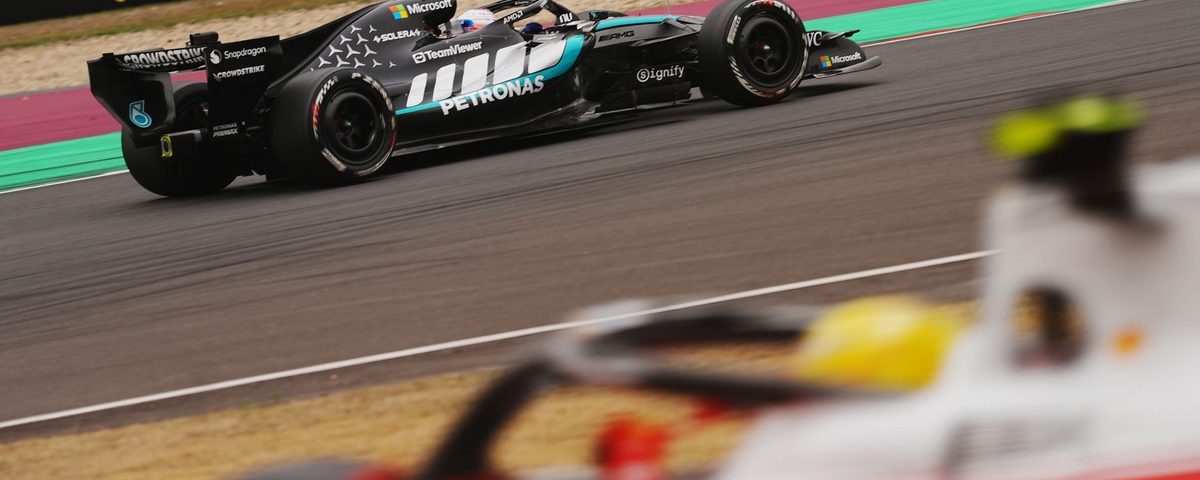
- Lewis Hamilton suggested Mercedes might still leverage a "party mode" for qualifying speed.
- Lando Norris firmly rejected this theory, attributing Mercedes' performance to consistent improvements.
- Mercedes has dominated qualifying sessions, often increasing their lead as the sessions progress.
- The debate highlights the strategic intricacies behind F1 engine performance and race tactics.
- As competition tightens, the implications of Mercedes' qualifying dominance could reshape the championship landscape.
Introduction: The Mercedes F1 Engine Debate
In the world of Formula 1, few topics ignite as much discussion as the performance capabilities of a team’s engine. Recently, the spotlight has turned to Mercedes, following Lewis Hamilton’s comments suggesting that the team might still employ a “party mode” for qualifying sessions. This assertion has been met with skepticism from McLaren driver Lando Norris, who argues that Mercedes’ impressive qualifying speed is a product of consistent engineering advancements rather than an obsolete tactic. This debate has emerged as the 2026 season unfolds, with Mercedes showcasing remarkable speed at races held in various locations worldwide.
The “Party Mode” Explained
Historically, the term “party mode” refers to a temporary power boost in an F1 engine, allowing teams to extract maximum performance during qualifying sessions. This mode is designed to provide a crucial advantage in the short, timed runs that determine grid positions. However, the 2021 regulations eliminated the use of such modes, prompting teams to focus on optimizing engine performance within more stringent guidelines.
Hamilton’s suggestion that Mercedes could still be utilizing a version of this tactic raises eyebrows, especially given the team’s recent performances. Norris’ rebuttal is significant; he emphasizes that Mercedes has made sustained improvements in their engine design and overall car setup, which are yielding results on track.
Tactical Breakdown: Mercedes’ Qualifying Strategy
The tactical dimensions behind Mercedes’ engine performance are intricate and multi-faceted. From a strategic standpoint, the team’s ability to maintain and enhance their power output throughout qualifying sessions plays a pivotal role in their success.
Engine Mapping and Power Delivery
One key aspect is the engine mapping — a critical factor that dictates how power is delivered to the tires. Mercedes has refined its engine mapping to ensure that power is not only maximized but also delivered smoothly, which aids in tire temperature management and overall stability during qualifying laps. This optimization is essential for maintaining momentum through corners and maximizing speed on straights, allowing the Silver Arrows to consistently outpace competitors.
Tire Management
Another crucial element in Mercedes’ qualifying strategy is tire management. The team’s understanding of how to maximize tire performance during a single lap has been a hallmark of their success. By efficiently warming their tires during the out-lap and maintaining optimal temperatures during the flying lap, Mercedes drivers can extract every ounce of performance from their cars, further widening the gap to rivals.
Competitive Landscape
However, this dominance in qualifying does not guarantee race success. The competitive landscape in Formula 1 is constantly evolving, with teams like Ferrari and Red Bull pushing the boundaries of performance. As these teams continue to develop their own engines and strategies, the margins in qualifying may narrow, and the importance of race pace becomes paramount.
Conclusion: A New Era of Competitive Balance
As the season progresses, the implications of this debate on Mercedes’ performance will be closely monitored. With Norris and Hamilton exchanging words, the narrative surrounding the team’s engine capabilities is sure to evolve. The question remains: will Mercedes continue to dominate in qualifying, or will their rivals find ways to level the playing field?
With the championship race heating up, how Mercedes approaches future qualifying sessions could define not only their immediate success but also their long-term strategy in the face of fierce competition.
FAQ:
Q: Who suggested that Mercedes F1 might still use a “party mode”?
A: Lewis Hamilton, a driver for Mercedes, suggested that the team might still benefit from a “party mode” in qualifying sessions.
Q: What was Lando Norris’s response to Hamilton’s theory?
A: Lando Norris, a driver for McLaren, rebuffed Hamilton’s suggestion, stating that Mercedes’ speed is due to consistent improvements rather than an outdated tactic.
Q: When did this debate about Mercedes’ engine performance arise?
A: The debate emerged during the early stages of the 2026 Formula 1 season, following Mercedes’ dominant performances in qualifying sessions.
From our perspective, the ongoing debate about Mercedes' engine capabilities encapsulates a broader narrative in Formula 1. As teams continue to innovate and refine their technologies, the line between what constitutes acceptable performance enhancements becomes increasingly blurred. While Hamilton's theory may hint at a nostalgic longing for the days of unlimited power boosts, Norris's rebuttal signals a shift towards a more nuanced understanding of engineering excellence.
Source: A "party mode" in Mercedes F1 engine? Lando Norris rebuffs Lewis Hamilton's theory
Sports News Plus is a news aggregator. We do not own or claim rights to any images, videos, or source content featured on this site. All images and media are the property of their respective original owners and publishers. Article content is independently written based on publicly available news sources, which are credited and linked throughout. Full disclosure →